Postgraduate Clinical Training Programs at PMC
Introduction
Peshawar Medical College is a constituent institution of Riphah International University. The college was established in 2005. The postgraduate training programme started in 2011 after duly fulfilling the PM&DC, HEC and University requirements. The programme offers both basic and clinical sciences postgraduate programmes. Clinical postgraduate training programmes mainly comprise the FCPS and MCPS programmes, recognized by the College of Physicians and Surgeons (CPSP) of Pakistan. We plan to introduce MS and postgraduate diploma programmes in certain specialties to meet the community needs.
Vision Statement
To produce doctors with clear objectives to help in long term development of the community through the following attributes;
- Professional competence
- Excellence in ethical values and practice
- Cognizance of community health care needs
- Research mindedness and lifelong learning
- Competence in IT and current health technologies
- Capability to successfully meet the local and global health challenges
- Competitiveness at national and global level
Mission Statement
Excellence in professional competence and ethical values
Educational Outcomes for the Postgraduate Medical Education
Our graduates of the PGME programs would be able to;
- Provide just, equitable and ethically driven high quality holistic specialist health care to the community;
- Communicate effectively with patients, their care givers, colleagues and other health care personnel;
- Contribute maximally to the advancement of bio-medical research and development of evidence-based health care interventions;
- Demonstrate effective team work in health care provision;
- Employ critical & reflective thinking, life-long learning and self-accountability for their continuing personal and professional development;
- Model exemplary moral conduct and be a mentor for the junior colleagues and students.
- Prove to be a socially responsible, honest , respectable and patriotic citizen.
FCPS & MCPS Programmes
The college is recognized for FCPS programme in the following specialties:
- Anesthesia
- Cardiology
- Endocrinology
- Gastroenterology
- General Medicine
- General Surgery
- Histopathology
- Neurosurgery
- Obstetrics & Gynaecology
- Ophthalmology
- Orthopedics Surgery
- Otorhinolaryngology (ENT)
- Orbit and Oculoplastics
- Paediatrics
- Paediatric Orthopedic Surgery
- Psychiatry
- Diagnostic Radiology
- Urology
- Vitero-Retinal Ophthalmology
The college is recognized for the MCPS programme in the following specialties:
- Obstetrics & Gynaecology
- Ophthalmology
- Anesthesia
- Paediatrics
- Diagnostic Radiology
Structure of the Programme and Curriculum
Postgraduate medical education (PGME) programmes at PMC, strive to produce specialist doctors that demonstrate excellence in professional skills, knowledge and ethical behaviour across various health care settings. Experienced, qualified supervisors with exemplary professional reputation are the central pillar of the postgraduate medical education at PMC. Our well-equipped training environment with a variety of case mix provide the necessary experiential learning for the postgraduate trainee (PGT). A well-established quality enhancement cell with qualified staff and IT support serves to strengthen the quality assurance mechanism designed for continuous improvement of PGME.
PMC strives to establish a culture of research and evidence-based practice for the undergraduate and postgraduate medical education. These educational interventions are supported by well-established department of undergraduate medical research (UMR) and office of research, innovation and commercialization (ORIC).
In the following section general guidelines are provided, details of the specific PGME programs are given in each of the specialty- specific curriculum document provided by the CPSP.
Competencies and learning outcomes
The FCPS programmes follow the CPSP curricula and postgraduate training regulations. These curricula are based on CPSP’s competency-based model of PGME as depicted in the following diagram.
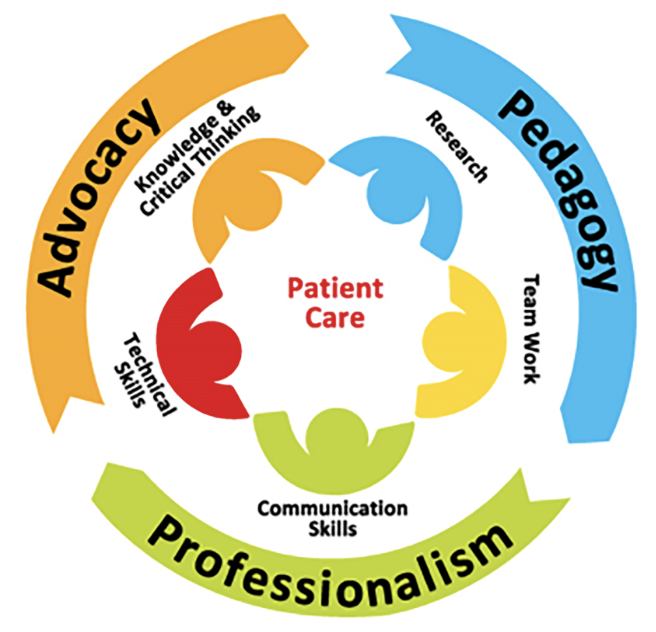
The model organizes postgraduate training around eight core competencies centered at patient and population care. These are visually depicted in the given diagram as an "inner" and "outer" circles, signifying integrated clinical and holistic professional development of the PGT. The inner circle represents five core competencies that shape patient care and the outer circle depicts three meta- competencies which contribute to the professional identify formation of the trainee. Each of these competencies guide several learning outcomes as prescribed by the CPSP in their curriculum document and reproduced in the following section.
1. Knowledge and Critical Thinking
- Demonstrate application of wide and current readings to critical thinking and problem solving;
- Relate the alteration of body function to the presenting condition;
- Interpret and integrate history and examination findings to arrive at an appropriate provisional and credible differential diagnoses;
- Sequentially order, justify and interpret appropriate investigations;
- Apply knowledge and reasoning skills to:
- Analyze data for problem identification and to rule in and rule out contending conditions;
- Synthesize and evaluate solutions for decision-making in solving familiar and less familiar problems based on best current evidence;
- Prioritize different problems within a time frame;
- Select, outline and provide, with evidence-based justifications, appropriate pharmacological and non-pharmacological management strategies;
- Assess new medical knowledge and apply it to resolve patient problems (Evidence-based practice);
- Apply quality assurance procedures in daily work (Professionalism);
- Demonstrate shared-decision-making with the patient or family;
- Provide cost-effective care while ordering investigations and in management;
- Use resources appropriately;
- Demonstrate awareness of bio-psycho-social factors in assessment and management of a patient.
2. Technical Skills
- Demonstrate International Patient Safety Goals (IPSG);
- Demonstrate competent performance of all required technical skills and procedures in the specialty, including:
- Obtaining informed consent;
- Preoperative planning;
- Pre-interventional care and preparation;
- Intra-Intervention technique including exposure and closure, global and task specific items, and communication and team skills;
- Post-interventional care;
- Follow-up Care.
3. Communication Skills
Written Communication Skills
- Maintain clear, concise, accurate and updated medical records
- Write clear, focused, evidence-based and logical management plans and discharge summaries
- Write respectful, clear and focused letters and referrals to other colleagues.
Verbal Communication Skills: Demonstrate:
- Effective interpersonal communication skills: clear, considerate and sensitive towards patients, their relatives, other health professionals and the public, and towards students;
- Non-verbal communication skills;
- Empathy and respect towards patients and their relatives;
- Effective counseling of the patient and the family with cultural sensitivity: explain options, educate them and promote joint decision-making;
- Appropriate verbal and body language on the campus and all work situations including seminars, bedside sessions, outpatient sessions and others;
- Respect and tolerance for all health care professionals including peers, juniors and seniors;
- Clear, focused and logical presentation of cases.
4. Teamwork
- Demonstrate constructive team-communication skills.
- Facilitate collaborative group interaction as a team member to build strong teams demonstrating respect, tolerance and interdependence.
- Support other team members to grow.
- Demonstrate willingness to assume responsibility and leadership as needed.
5. Research
- Interpret and use results of various research studies (critical appraisal);
- Conduct a research study individually or in a group by using appropriate:
- Selection of research question(s) and objectives
- Research design and statistical methods to answer the research question
- Ethical and R&RC approval of the synopsis
- Demonstrate competence in academic writing by writing an appropriate dissertation and/or publishing research article(s) as a step towards resolving issues or concerns in their specialty;
- Guide others in conducting research by advising about research methodology including study designs and statistical methods;
- Demonstrate clear, focused and logical presentations of their research.
6. Professionalism
- Demonstrate the highest level of personal integrity: honesty, punctuality, regularity, timely task completion;
- Deal with all patients in a non-discriminatory, prejudice- free manner, demonstrating the same level of care for every human being irrespective of gender, age, ethnic background, culture, socioeconomic status and religion;
- Establish a trusting relationship with patients, their relatives and care-givers;
- Deal with all patients with honesty, empathy and compassion, putting patients’ needs first (altruism);
- Facilitate transfer of information important for promotion of health, prevention and management of disease;
- Encourage questioning by the patient and be receptive to feedback;
- Pursue self-directed and life-long learning. Keep abreast of medical literature and assess new knowledge and apply it to resolve patient problems;
- Know one’s limitations and ask for help as needed from colleagues, consultations or referrals;
- Apply quality assurance procedures for improvement in daily work;
- Be a role model for others.
Ethics
- Maintain patient autonomy by demonstrating shared- decision-making with the patient and/or family;
- Obtain informed consent, maintain patient confidentiality and do no harm;
- Provide cost-effective care while ordering investigations and in management and use resources appropriately.
Leadership
- Demonstrate accountability for their decisions and actions, and that of their team;
- Demonstrate willingness to assume leadership role(s) when needed in given situations or events (rush call/code);
- Change and bring about change as necessary, as a leader or supportive leader.
7. Pedagogy
Should be able to demonstrate competence in teaching skills:
- Effective clinical/community-based teaching
- Some evidence of acquisition of theory regarding learning and education
- Practice some of the best teaching methods.
8. Advocacy
Advocacy is needed at multiple level:
- Advocacy for the Patient
Doctors and nurses are the advocates of the patients, otherwise patients are likely to be lost in the system.
All care should be timely, putting patients first.
- Advocacy for the Practice
Working in a service or practice, doctors must highlight limitations and issues.
They must identify solutions for the problems, and recommend and implement improvements for the practice(s) and institutional system(s).
- Advocacy for the Health System and Society
Know one’s role in the Health System(s) and build strong referral systems
Keep patient and community interests paramount, above one’s own personal or professional interest
Demonstrate advocacy for elimination of the social determinants of health
Demonstrate advocacy for prevention of serious illnesses of their specialty/sub-specialty.
- For the Profession
Strive for building trust in the public for your profession.
Demonstrate improvement and enhancement of profession, specialty and sub-specialty.
Be conscientious gate-keepers of their profession, specialty and subspecialty.
Peshawar Medical College
Recognized FCPS-II Training Programs
Recognized MCPS Training Programs
Peshawar Dental College
Recognized FCPS-II Training Programs
Recognized MCPS Training Programs

 Peshawar Medical College